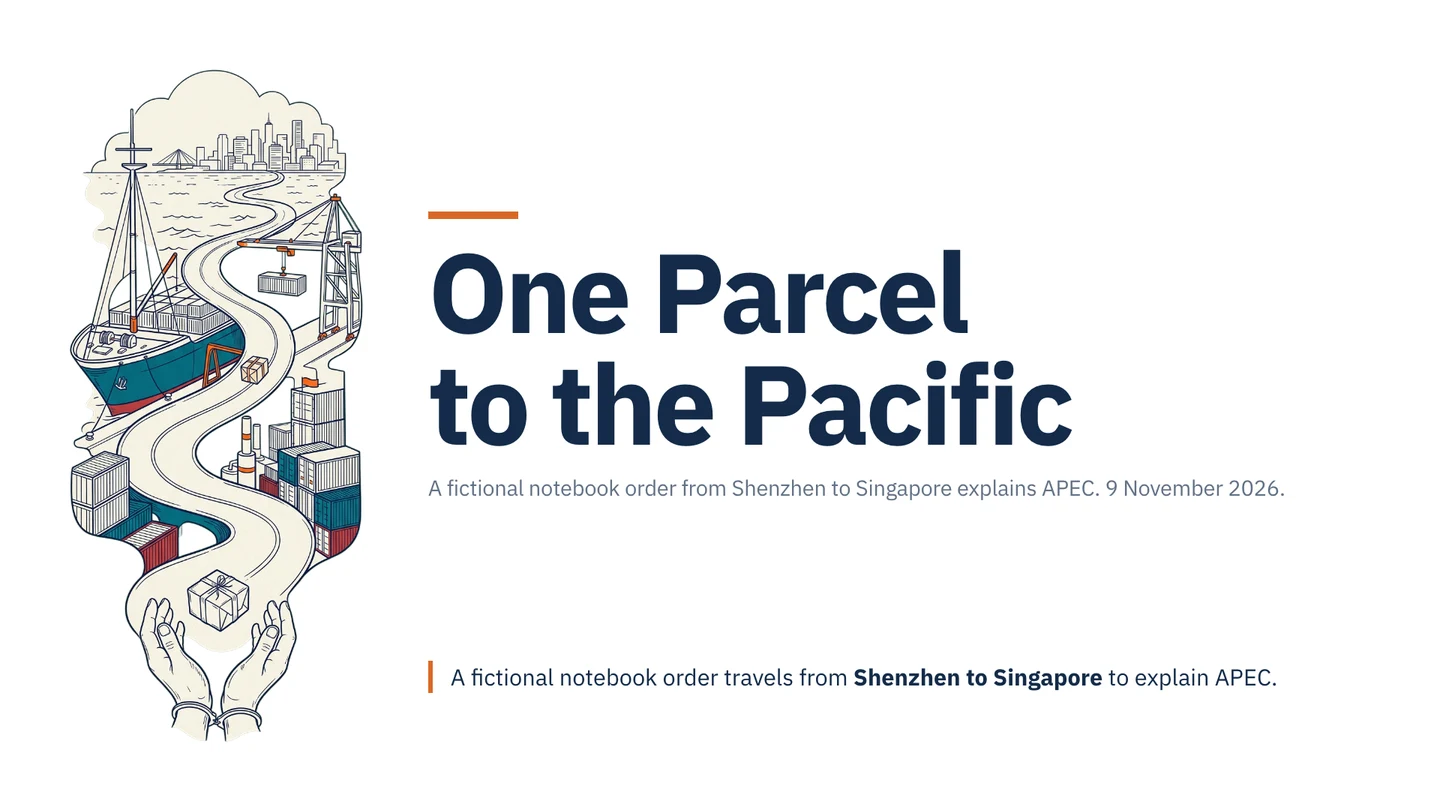
One Parcel to the Pacific
A fictional notebook order from Shenzhen to Singapore explains APEC. 9 November 2026.
A fictional notebook order travels from Shenzhen to Singapore to explain APEC.
Trade · 8 slides · Swiss
A Singapore reader orders a notebook from Shenzhen. Follow the payment, the parcel and its customs declaration to see what Asia-Pacific trade cooperation could change for a small shop.
Reporting cutoff: 9 November 2026, ahead of Leaders’ Week. The shop and order are fictional. Illustrations depict the example journey.
For small merchants, students and readers who want to connect the Shenzhen APEC agenda to the practical work of shipping a cross-border order. Use the notebook’s journey to trace who handles the money, the goods and the declaration.
Slide 2 preview
Slide 3 preview
Slide 4 preview
Slide 5 preview
Slide 6 preview
Slide 7 preview
Slide 8 preview
The order follows three paths: the payment, the physical notebook and its customs data. The closing slides connect those paths to the meeting agenda and the shop’s next order.
See how the starting material becomes a structured presentation.
One Parcel to the Pacific — A Shenzhen APEC field guide, reporting cutoff 9 November 2026. Audience: curious readers and small merchants. Narrative device: a fictional independent Shenzhen stationery shop receives an online order from a Singapore reader for one illustrated paper notebook. It is sent by post. No real buyer, quoted fee, promised transit time, shipment statistics or measured change in this shop's costs.
The order comes in. On a phone in Singapore the buyer sees a price and a payment confirmation. In the shop in Shenzhen the seller still has a notebook to pack and a payout to reconcile. Follow the book, its data and the money. The question is what practical trade cooperation can do for a small merchant.
Payment has two clocks. The buyer can finish checkout before the marketplace pays the merchant. Platforms differ in how frequently they pay sellers. If the seller is paid in another currency, the conversion rate affects the amount received; a slower payout ties up money the shop could use to buy paper. APEC's study of small businesses in e-commerce describes payout timing and currency conversion as real frictions. Do not assume this transaction used any particular payment network or rate. https://www.apec.org/apecapi/publication/getfile?publicationId=0a88eee3-7213-4f76-9ac5-089ce11490b3
At the counter the notebook gets a second identity, a customs declaration. Its contents can be described as one paper notebook; a vague description like “stuff” gives an inspector little to go on. The sender supplies accurate shipment details including contents and value. Postal operators exchange advance electronic information; destination customs can use it to assess risk. Sending a record in advance does not automatically release the shipment. Primary source: Universal Postal Union, Customs. https://www.upu.int/en/postal-solutions/programmes-services/postal-supply-chain/customs
Two journeys through the postal network. Physical path in the example: seller packs notebook, origin post accepts it, international transport, destination post, local delivery. Information path: sender provides declaration, origin post sends advance data, destination customs assesses it and may require further checks. The parcel can be moving while its data are being reviewed. No specific airport, operator or inspection outcome is claimed. UPU–WCO Postal Customs Guide: https://www.upu.int/UPU/media/upu/files/postalSolutions/programmesAndServices/postalSupplyChain/customs/guideWcoUPUCustomsEn.pdf
At the border the reader wants a delivery estimate, the seller wants fewer requests for clarification, and customs needs enough information to decide whether a closer look is warranted. Goods descriptions illustrate the practical trade-off. Good information can reduce unnecessary back-and-forth while preserving the authority to inspect. APEC customs officials and businesses discussed electronic certification, paperless processes, and treatment of e-commerce goods in Dalian. Source, 3 Sep: https://www.apec.org/press/news-releases/2026/0903_acbd
Why paperless trade is on the agenda. An invoice exchanged as a file may still require someone to retype its fields if systems cannot interpret them. In an interoperable exchange a receiving system can reuse fields such as quantities and descriptions. APEC reported research estimating that digitalizing trade documents could lower trade transaction costs by 5.8 percent. This is a potential aggregate effect on trade transaction costs, not a 5.8% discount on the notebook, a postage saving, or a promise by Shenzhen leaders. Source, APEC Secretariat, 3 November: https://www.apec.org/press/news-releases/2026/apec-advances-trade--ai-cooperation-ahead-of-leaders--week
Why Shenzhen is in the story. APEC brings 21 member economies together; its discussions help economies share approaches. On 3 November the Secretariat highlighted trade facilitation, digital interoperability and AI cooperation. Leaders' Week is scheduled to start on 14 November with senior officials and business meetings. The Economic Leaders' Meeting is scheduled for 18–19 November in Shenzhen according to the official calendar. The host priorities are openness, innovation and cooperation. The 4 November ministerial release singled out port connectivity, single-window systems and digital trade procedures. Describe priorities and scheduled meetings as of 9 November; do not attribute an adopted deal or binding border change to the upcoming meeting. https://www.apec.org/ https://www.apec.org/press/news-releases/2026/1104_AMM
Close by putting the notebook in the reader's hands and asking what a shopkeeper could actually measure on its next shipment. Three suggested measures: days from checkout to payout; number of times the same declaration fields must be entered; number of clarification requests before release. These are illustrative tests, not reported statistics or summit commitments. End with a direct question to the reader: Which would you measure on your next order?
A fictional notebook order from Shenzhen to Singapore explains APEC. 9 November 2026.
A fictional notebook order travels from Shenzhen to Singapore to explain APEC.
Platform payout schedules vary; where currencies differ, conversion affects the amount received.
Singapore buyer — Sees checkout confirmation — payment completes at the point of purchase.
Shenzhen seller — Waits for a marketplace payout — the money arrives on the platform's schedule.
A slower payout ties up money the seller needs for buying paper. APEC research on small merchants highlights this timing gap.
Primary source: Universal Postal Union, Customs
Accurate contents — The contents can be described as one paper notebook.
Vague descriptions — A description like “stuff” gives an inspector little to go on.
Sender's details — The sender supplies accurate shipment details including contents and value.
Advance data — Postal operators exchange advance electronic information; destination customs can use it to assess risk.
No automatic release — Sending a record in advance does not automatically release the shipment.
Physical movement and declaration data, per UPU and WCO
Origin post
International transport
Local delivery
Sender declares item
Origin post transmits data
Destination customs assesses risk
Origin post → International transport
International transport → Local delivery
Sender declares item → Origin post transmits data
Origin post transmits data → Destination customs assesses risk
Dalian customs–business dialogue, 3 September 2026. Clear descriptions help a reviewer while leaving inspection available.
Reader — When will it arrive?
Seller — Will I need to explain the contents again?
Customs — Is there enough information to decide whether to inspect?
APEC Secretariat, 3 November 2026
Aggregate research estimate — Digitalizing trade documents could lower trade transaction costs by 5.8 percent — a potential aggregate effect.
This notebook order — The effects on postage and sale price are unknown; it is not a 5.8% discount, a postage saving or a promise by Shenzhen leaders.
An invoice exchanged as a file may still require someone to retype its fields if systems cannot interpret them; in an interoperable exchange a receiving system can reuse fields such as quantities and descriptions.
21 member economies; openness, innovation and cooperation
1. 4 Nov — APEC ministerial briefing identifies port connectivity, single-window systems and digital trade procedures.
2. 14 Nov — Leaders’ Week scheduled to open with senior officials and business meetings.
3. 18–19 Nov — Economic Leaders’ Meeting scheduled in Shenzhen.
Three suggested measures for the shopkeeper — no observed values
Checkout to payout — Days from checkout to payout shows how long the shopkeeper's money is tied up before it arrives.
Customs re-entry — Times the same customs fields were re-entered shows how much duplicate paperwork the order demands.
Clarification requests — Clarification requests before release show how often an order stalls on questions before it can ship.
Pick one product, origin and destination so readers can follow the same order.
Show who handles the money, the goods and the declaration at each stage.
Identify what a regional estimate measures before drawing conclusions about one seller.
Check meeting dates against the APEC calendar and distinguish a scheduled discussion from an adopted decision.
Use this example as a reference when creating your own presentation. Replace illustrative data with verified information and review each slide before presenting.