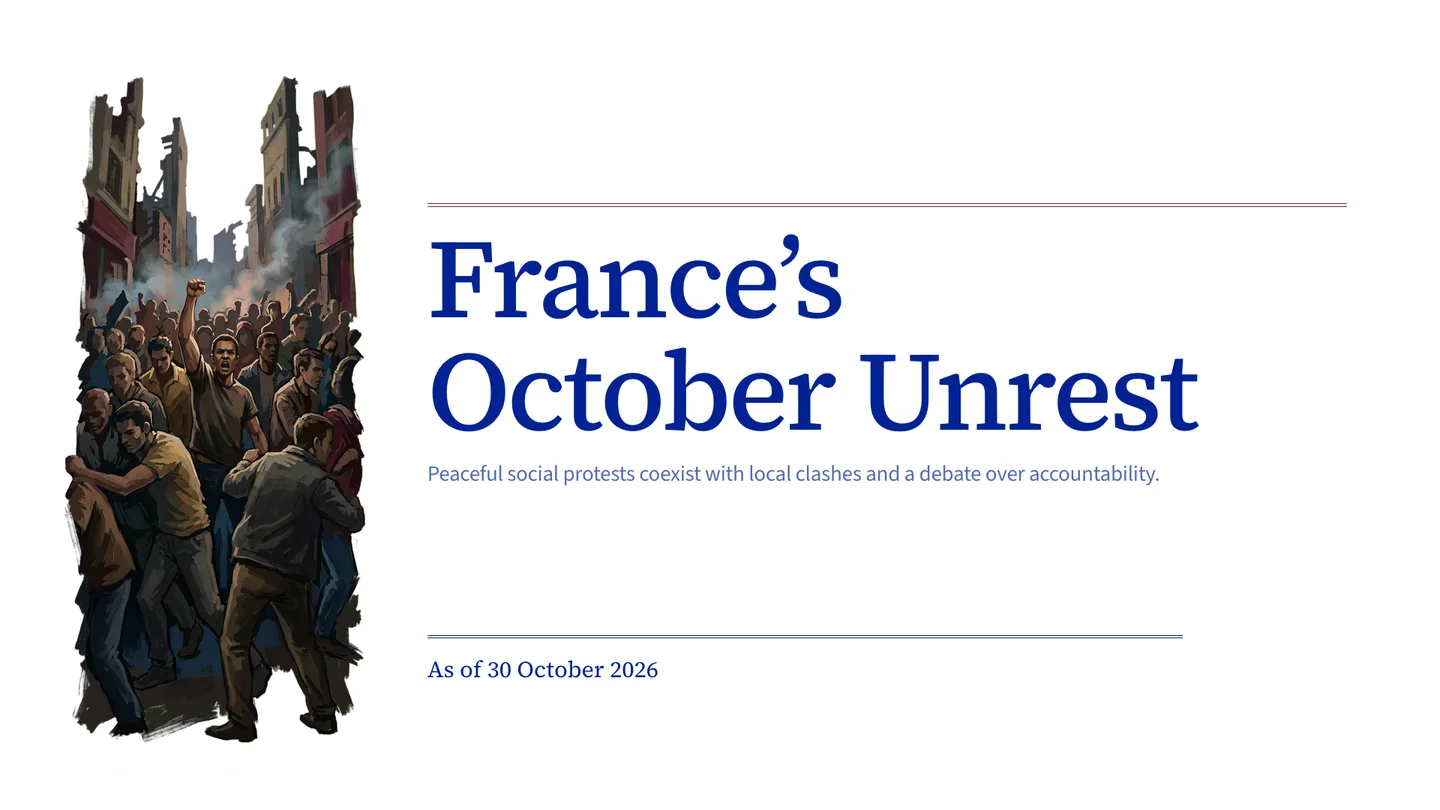
France’s October Unrest
Peaceful social protests coexist with local clashes and a debate over accountability.
As of 30 October 2026
Current affairs · 8 slides · Editorial magazine
An eight-slide editorial briefing that separates social grievances, competing turnout estimates, provisional figures and the debate over accountability.
Archived presentation · Source cutoff: 30 October 2026. The original slide content is preserved; this Gallery edition is not a news update or a new fact-check. Illustrations are editorial interpretations, not documentary photographs.
For readers and presenters exploring how to turn a complex current-affairs source into a clear editorial briefing. This eight-slide example keeps social grievances, reported incidents, competing estimates and policy proposals in distinct sections.
Slide 2 preview
Slide 3 preview
Slide 4 preview
Slide 5 preview
Slide 6 preview
Slide 7 preview
Slide 8 preview
The opening establishes the scope and cutoff date. The deck then moves from education grievances to reported events, compares turnout estimates for the same day, distinguishes separate provisional measures, and closes with accountability questions and watchpoints.
See how the starting material becomes a structured presentation.
Prepare an English-language public news explainer for general readers, exactly eight slides, Detailed information density. Research cutoff: 30 October 2026. Separate peaceful protest, reported violence, official allegations and editorial interpretation. Keep source labels and dates visible but concise. Use varied structured components only when the actual information relationships warrant them. Do not invent quotes, figures, causes, images of identifiable events, or predictions. Illustrations are editorial interpretations, not documentary evidence.
According to CFR's 28 October explainer, teachers at Antoine de Saint-Exupéry High School in Créteil struck on 17 September over staffing shortages. Students and parents joined; videos helped spread the action. Grievances included missing teachers, crowded classrooms, deteriorating buildings and dissatisfaction with the Parcoursup admissions platform. Teachers, parents, university students and political supporters joined the movement. Yellow Vest participation brought cost-of-living and anti-austerity concerns into the coalition. These participants should not all be equated with people committing violence. CFR is an analytical source, not a government statement. [CFR, 28 Oct]
Reuters reported largely peaceful nationwide marches followed by clashes, including Paris and Marseille. The Interior Ministry counted 410,000 participants; organisers gave a substantially higher estimate (800,000 in Euronews' next-day account). These are competing estimates of the same day, not different dates or a growth trend. The state deployed 70,000 police and gendarmes, 10,000 more than the previous week. Reuters described shuttered shops, precautionary museum closures and more than 20 closed metro stations in Paris. Do not imply the entire country or every march was violent. [Reuters, 24 Oct; Euronews, 25 Oct]
Euronews reported the Interior Ministry's provisional national October 24 figures: 1,314 arrests, 53 security personnel injured, and 24 shops looted. These are different measures: do not put them into a single comparative chart. Arrests do not establish guilt. The ministry did not publish a nationwide total for injured protesters in this account; absence of a total does not mean zero injuries. The same report gives comparable fire-response counts: 2,025 on the previous mobilisation weekend versus 75 on October 24. Use a simple two-period comparison with the unit 'fire interventions' and official attribution. These are interventions, not counts of all fires, burned vehicles or all acts of violence. Lower recorded fire responses do not establish that grievances have been resolved or that every kind of violence declined equally. [Euronews, 25 Oct]
The Doubs prefecture's October 17 statement describes police intervention in Besançon against urban violence and reports nine arrests connected with fireworks, damage and looting. This is a local official report, not a national total; attribute the allegations. It is an example of the distinction between a demonstration and violent groups within it. The page's search extract was accessible but direct retrieval failed, so omit this optional detail from final slides unless independently verified. [Doubs prefecture, 17 Oct]
The Senate's official legislative summary says the government introduced its public-space damage compensation bill on September 16, BEFORE the October 17 escalation. The Senate approved it overnight October 27–28, by 229 votes to 105. It remains a bill in progress, not an enacted law. Do not confuse it with a separate parliamentary proposal introduced October 13. The Senate summary describes proposed joint civil liability, capped at EUR10,000, for people knowingly participating in a violent group or remaining despite dispersal warnings under the specified conditions, even without personally damaging property. It also describes collection from certain family/housing benefits and Senate amendments covering additional benefits. The text includes legitimate-reason exemptions, such as journalists or observers. Explain proposals in accessible terms without giving legal advice. [French Senate, 28 Oct]
AP's October 30 account frames the dispute: supporters want compensation for victims and accountability for damage; critics fear harm to benefit-dependent families and deterrence of peaceful protest. Distinguish these positions from proven outcomes. Wider liability is a proposed response, not evidence that it will deter unrest. Keep the debate about compensation, individual responsibility and protest rights, not a moral judgment on all demonstrators. [AP, 30 Oct]
Euronews reported calls for another mobilisation on October 31. This is a planned event after the research cutoff, not an event that has already happened. Editorial watchpoints: whether social demands receive a concrete response; whether peaceful mobilisation and violent incidents diverge; whether provisional figures are revised; how the compensation bill progresses and its safeguards change. These are questions, not predictions. Do not claim that the unrest is over or will inevitably escalate.
CFR (28 Oct): https://www.cfr.org/articles/whats-behind-the-protests-and-riots-in-france-and-what-comes-next Reuters via Investing.com (24 Oct): https://www.investing.com/news/world-news/france-mounts-huge-security-operation-to-prevent-protest-violence-4970771 Euronews (25 Oct): https://fr.euronews.com/2026/10/25/manifestations-en-france-1-314-interpellations-53-membres-des-forces-de-lordre-blesses-sam French Senate (28 Oct): https://www.senat.fr/travaux-parlementaires/textes-legislatifs/la-loi-en-clair/projet-de-loi-relatif-a-la-reparation-des-dommages-resultant-de-violences-ou-de-degradations-commises-dans-lespace-public-et-au-recouvrement-des-dommages-et-interets.html AP (30 Oct): https://apnews.com/article/france-riots-student-protests-macron-parents-cost-5655523ee7ab8295b47c78caeb958a2e Optional local report (retrieval incomplete): https://www.doubs.gouv.fr/Publications/Salle-de-Presse/Communiques-de-presse/Annee-2026/Bilan-departemental-de-la-journee-du-17-octobre-2026
Peaceful social protests coexist with local clashes and a debate over accountability.
As of 30 October 2026
CFR's 28 October explainer is an analytical source, not a government statement.
School action — Teachers at Antoine de Saint-Exupéry High School in Créteil struck on 17 September over staffing shortages; students and parents joined, and videos helped spread the action.
Grievances — Missing teachers, crowded classrooms, deteriorating buildings and dissatisfaction with the Parcoursup admissions platform.
Coalition — Teachers, parents, university students and political supporters joined; Yellow Vest participation brought cost-of-living and anti-austerity concerns.
Distinction — These participants should not all be equated with people committing violence.
Reuters, 24 October; Euronews, 25 October
Marches — Reuters reported largely peaceful nationwide marches.
Clashes — Clashes followed, including in Paris and Marseille; the entire country and every march were not violent.
Security — The state deployed 70,000 police and gendarmes, 10,000 more than the previous week.
Paris disruption — Shuttered shops, precautionary museum closures and more than 20 closed metro stations in Paris.
October 24, 2026; these are competing estimates of one day, not different dates or a growth trend.
Interior Ministry — Counted 410,000 participants nationwide.
Organisers — Gave a substantially higher estimate of 800,000, per Euronews' next-day account.
Interior Ministry provisional national figures, reported by Euronews on 25 October 2026
Arrests — 1,314 arrests nationally on a provisional basis; arrests do not establish guilt.
Security personnel injured — 53 security personnel injured, a separate measure from arrests.
Shops looted — 24 shops looted, a separate measure from arrests and injuries.
Injured protesters — The ministry supplied no nationwide total for injured protesters; missing does not mean zero.
Interior Ministry provisional figures, attributed via Euronews, 25 October 2026
Previous mobilisation weekend — 2025
24 October 2026 — 75
These are fire interventions, not counts of all fires, burned vehicles or all acts of violence. Lower recorded fire responses do not establish that grievances have been resolved or that every kind of violence declined equally.
French Senate, 28 October; a bill in progress, not an enacted law, introduced 16 September before the October 17 escalation.
Proposal — Joint civil liability capped at EUR10,000 for people knowingly participating in a violent group or remaining despite dispersal warnings under specified conditions, even without personally damaging property.
Recovery — Collection from certain family and housing benefits, with Senate amendments covering additional benefits.
Exemptions — Legitimate-reason exemptions, such as journalists or observers.
Trade-off — AP, 30 October: supporters want compensation for victims and accountability for damage; critics fear harm to benefit-dependent families and deterrence of peaceful protest.
Editorial watchpoints are questions, not predictions; the unrest is neither declared over nor forecast to escalate.
Next mobilisation — Euronews reported calls for another mobilisation on October 31, a planned event after the research cutoff.
Figures — Whether the provisional figures are revised.
Bill — How the compensation bill progresses and whether its safeguards change.
Policy — Whether social demands receive a concrete response, and whether peaceful mobilisation and violent incidents diverge.
Start with a dated source brief. Separate national reporting from local incidents, and distinguish peaceful participation from reported violence.
Label who supplied each estimate. Compare only like-for-like measures, preserve units and caveats, and identify missing information instead of treating it as zero.
Distinguish proposed policy from enacted rules. Use closing watchpoints to explain what remains uncertain without turning them into predictions.
This is a preserved presentation with a 30 October 2026 source cutoff, not an updated news report. Review the original reporting and legislative status before reusing factual claims. The generated illustrations interpret the subject; they are not photographs of the events.
Use this example as a reference when creating your own presentation. Replace illustrative data with verified information and review each slide before presenting.