Start with the moment the heat shield drops
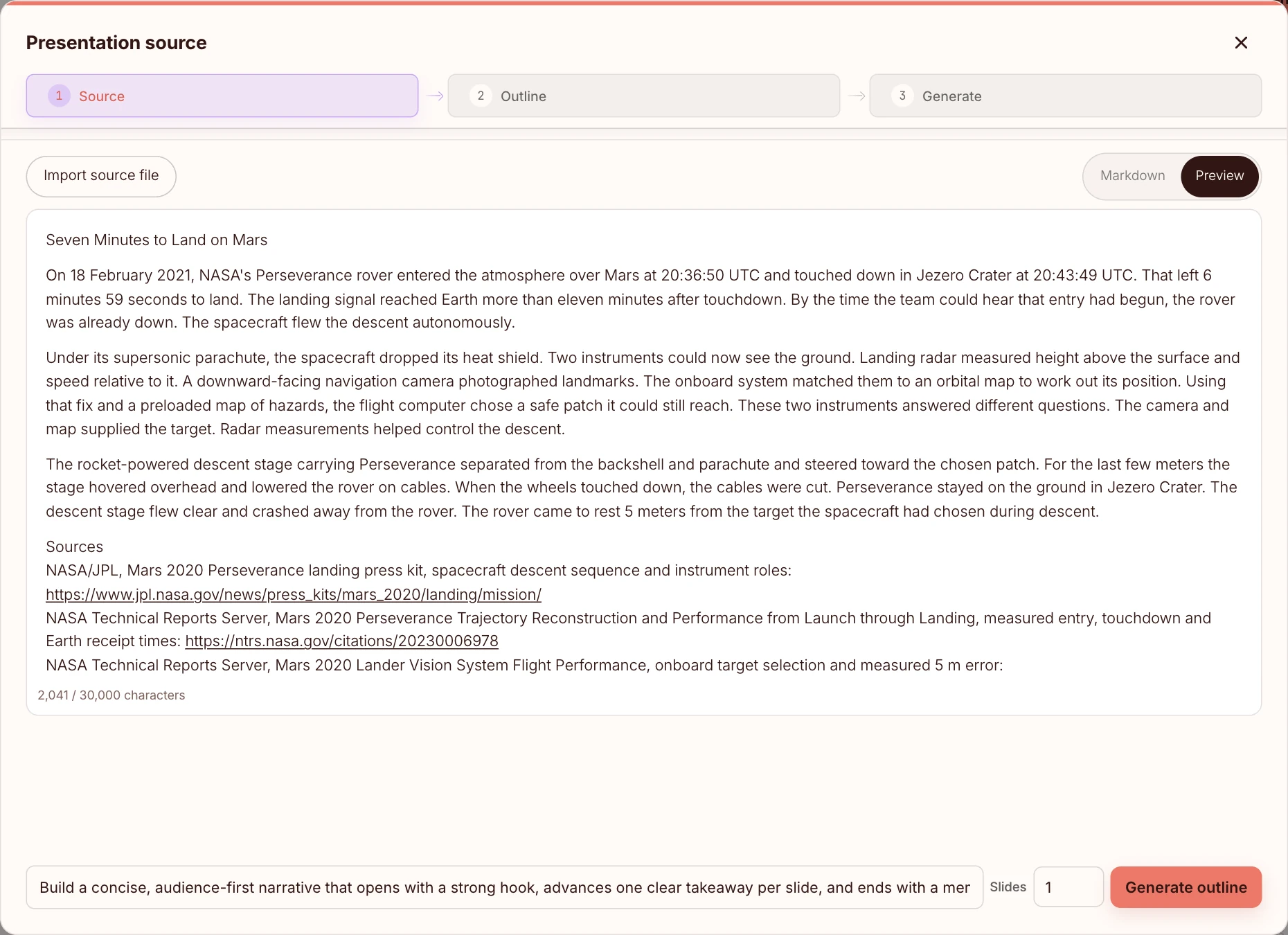
User brings the landing notes into Flamigo. The first fork appears as soon as the heat shield falls away. With the ground in view, the radar measures height and speed while the camera picks out landmarks. On the page, one sentence follows the other. In flight, both instruments are already at work.
Give each arrow a job in the DSL
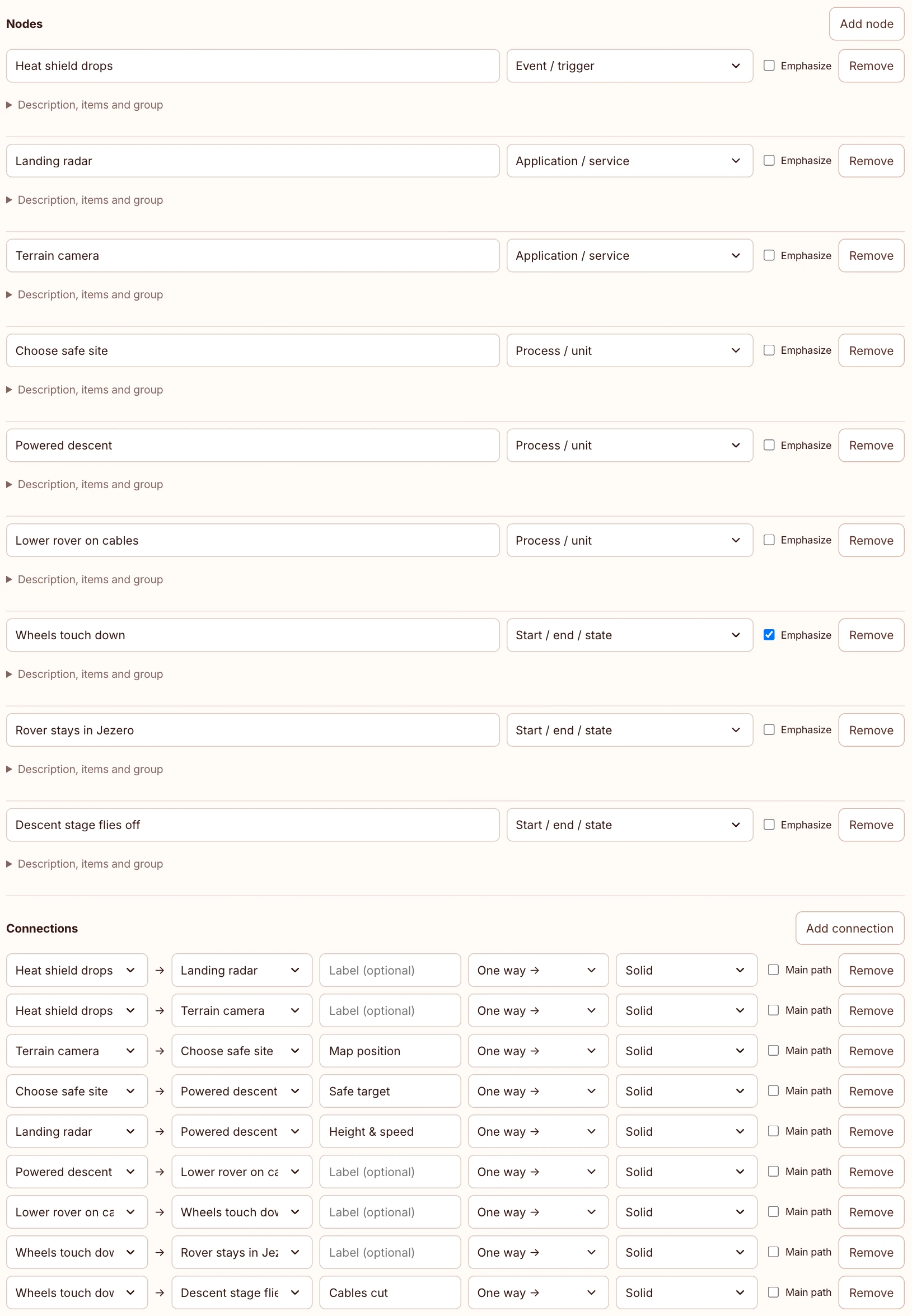
Flamigo turns the notes into a diagram DSL. User can now trace two paths into “Powered descent.” Follow the camera and the map, and the spacecraft has a safe place to aim for. Follow the radar, and it knows how high it is and how fast it’s coming down.
Follow the landing all the way to touchdown
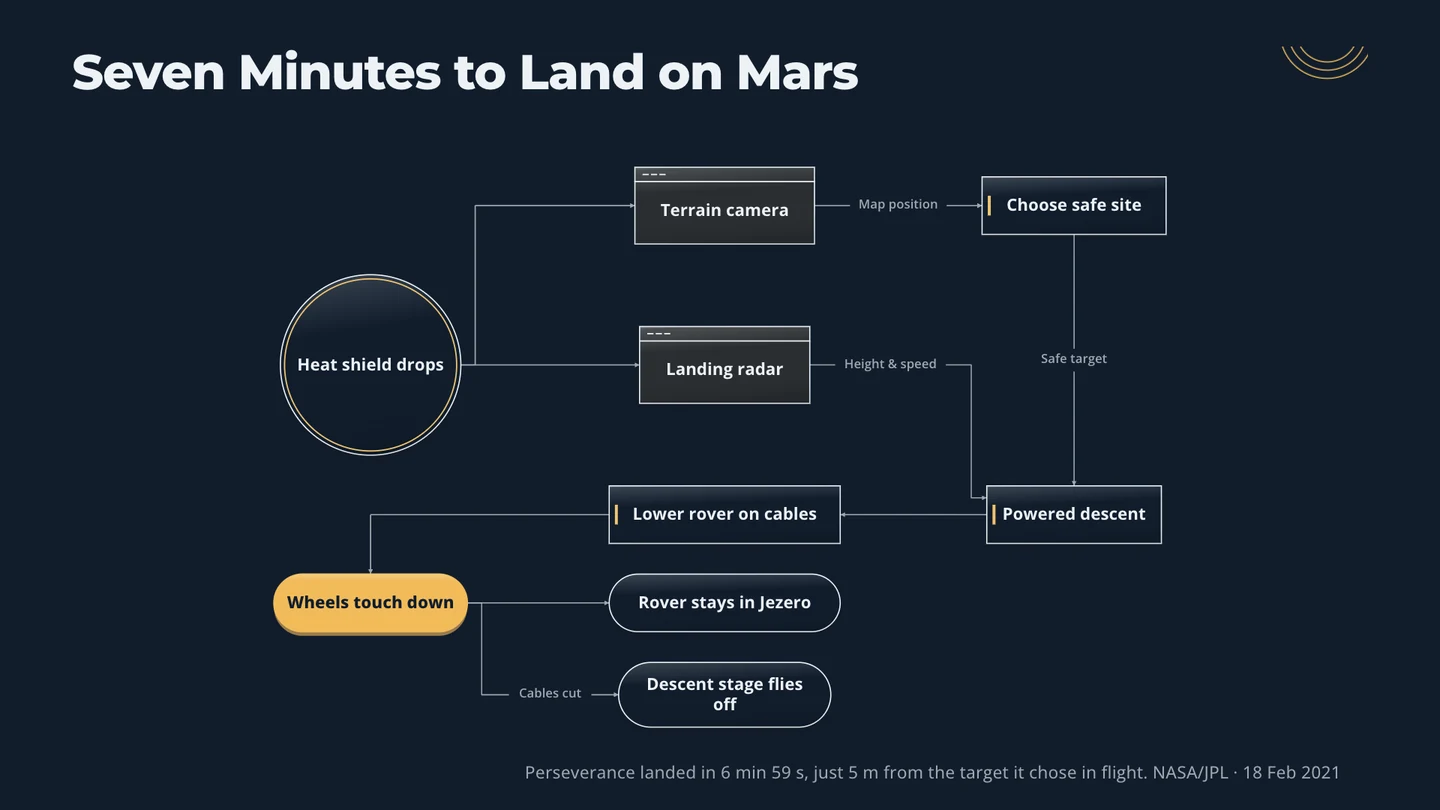
Flamigo renders the flowchart on one slide. User can follow the rover as it’s lowered on cables. The arrow leads straight into the yellow “Wheels touch down” node. There the story splits one last time. Perseverance stays in Jezero Crater. The cables are cut, and the descent stage flies clear.
Seven Minutes to Land on Mars
Original notes and slide text
Seven Minutes to Land on Mars
On 18 February 2021, NASA's Perseverance rover entered the atmosphere over Mars at 20:36:50 UTC and touched down in Jezero Crater at 20:43:49 UTC. That left 6 minutes 59 seconds to land. The landing signal reached Earth more than eleven minutes after touchdown. By the time the team could hear that entry had begun, the rover was already down. The spacecraft flew the descent autonomously.
Under its supersonic parachute, the spacecraft dropped its heat shield. Two instruments could now see the ground. Landing radar measured height above the surface and speed relative to it. A downward-facing navigation camera photographed landmarks. The onboard system matched them to an orbital map to work out its position. Using that fix and a preloaded map of hazards, the flight computer chose a safe patch it could still reach. These two instruments answered different questions. The camera and map supplied the target. Radar measurements helped control the descent.
The rocket-powered descent stage carrying Perseverance separated from the backshell and parachute and steered toward the chosen patch. For the last few meters the stage hovered overhead and lowered the rover on cables. When the wheels touched down, the cables were cut. Perseverance stayed on the ground in Jezero Crater. The descent stage flew clear and crashed away from the rover. The rover came to rest 5 meters from the target the spacecraft had chosen during descent.
Sources NASA/JPL, Mars 2020 Perseverance landing press kit, spacecraft descent sequence and instrument roles: https://www.jpl.nasa.gov/news/press_kits/mars_2020/landing/mission/ NASA Technical Reports Server, Mars 2020 Perseverance Trajectory Reconstruction and Performance from Launch through Landing, measured entry, touchdown and Earth receipt times: https://ntrs.nasa.gov/citations/20230006978 NASA Technical Reports Server, Mars 2020 Lander Vision System Flight Performance, onboard target selection and measured 5 m error: https://ntrs.nasa.gov/citations/20230006986
The walkthrough follows the web interface. The featured slide was generated from the same notes through Flamigo’s MCP interface and edited for clarity. The NASA sources below document the landing.
Sources
Seven Minutes to Land on Mars
Heat shield drops
Landing radar
Terrain camera
Choose safe site
Powered descent
Lower rover on cables
Wheels touch down
Rover stays in Jezero
Descent stage flies off
Heat shield drops → Landing radar
Heat shield drops → Terrain camera
Terrain camera → Choose safe site — Map position
Choose safe site → Powered descent — Safe target
Landing radar → Powered descent — Height & speed
Powered descent → Lower rover on cables
Lower rover on cables → Wheels touch down
Wheels touch down → Rover stays in Jezero
Wheels touch down → Descent stage flies off — Cables cut