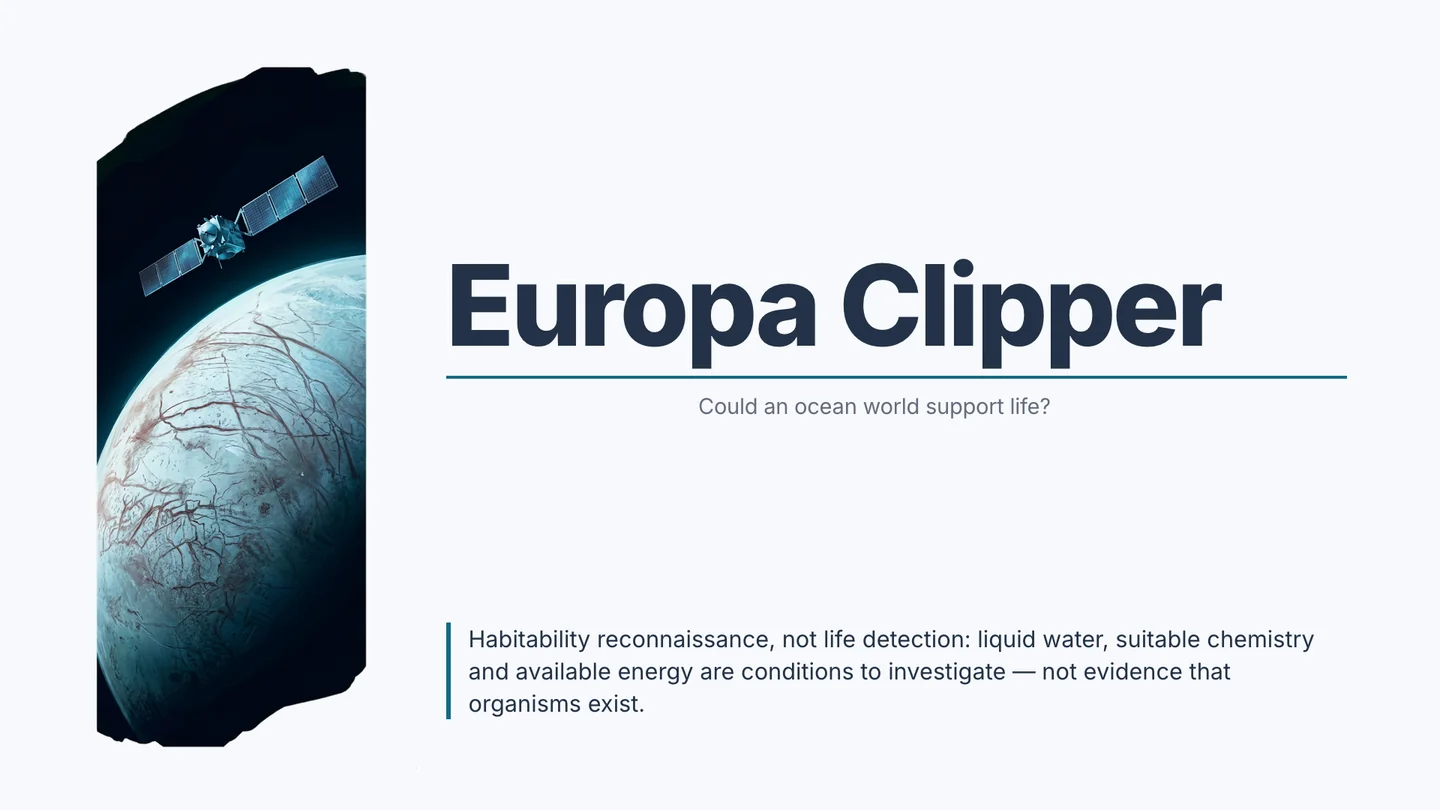
Europa Clipper
Could an ocean world support life?
Habitability reconnaissance, not life detection: liquid water, suitable chemistry and available energy are conditions to investigate — not evidence that organisms exist.
Science · 8 slides · Swiss
An eight-slide science explainer about Europa Clipper’s mission, instruments and evidence, distinguishing habitable conditions from proof of life.
Science presentation · Source snapshot: 30 October 2026. This is an educational example, not a live mission update. Cutaway views are conceptual illustrations, not measured interior maps.
For educators, science communicators and curious readers exploring how to explain a planetary mission without turning research objectives into discoveries. This eight-slide example separates mission scope, engineering constraints, complementary measurements and limits of inference.
Slide 2 preview
Slide 3 preview
Slide 4 preview
Slide 5 preview
Slide 6 preview
Slide 7 preview
Slide 8 preview
The opening defines habitability and what the mission cannot prove. Three science objectives lead into separate flyby metrics and engineering constraints. A four-instrument comparison table connects observations to scientific context; a four-step evidence chain leads into four open questions and an explicit limit on claims of life.
See how the starting material becomes a structured presentation.
Research snapshot: 30 October 2026. English science explainer, eight pages, Detailed. This is a general scientific regression case, not a claim that this is today's hottest news. Use only these facts and distinguish plans from findings. Do not invent detections, species, ocean measurements, budgets, performance charts or probabilities.
NASA's main question is whether environments below Europa's surface could support life. This is habitability reconnaissance, not a mission carrying life-detection instruments. Liquid water, suitable chemistry and available energy are conditions to investigate; none establishes that organisms are present. Describe the ocean as strongly supported by prior evidence, while its properties and connection to the surface remain research questions. Avoid headlines announcing life found. Source: https://europa.nasa.gov/mission/faq/
NASA launched Europa Clipper on 14 October 2024. It carries nine scientific instruments. Its three broad science objectives concern the ice shell and ocean, composition, and geology. The spacecraft orbits Jupiter and repeatedly passes Europa; it does not remain in orbit around Europa. NASA describes nearly 50 close flybys, some approaching about 25 km above the surface. Flybys cover different locations. Large solar arrays support operation far from the Sun; deployed span exceeds 30.5 m. Jupiter's radiation environment is a major design constraint. These quantities have different units and should be individual metrics, not bars on one axis. Source: https://science.nasa.gov/mission/europa-clipper/mission-overview/
EIS uses wide-angle and narrow-angle cameras for stereo views, terrain elevations and geological context. E-THEMIS measures infrared emission to identify relatively warm regions and surface texture. Europa-UVS examines ultraviolet signatures of gases and materials, including possible plume activity. MISE maps infrared signatures of surface composition. Interpret these as complementary measurements; a warm region or a plume candidate is not direct proof of life. The instruments collect observations during the same flybys so evidence can be compared in context. Source: https://science.nasa.gov/mission/europa-clipper/spacecraft-instruments/
The spacecraft also uses ice-penetrating radar to investigate subsurface structure, magnetometer measurements to examine the induced magnetic response, and plasma measurements to help interpret the surrounding environment. The magnetic approach can constrain characteristics such as ocean depth and salinity, but these are mission objectives rather than measured final results. Particle and gas observations can investigate material around Europa. Remote sensing connects indirect evidence to models; different instruments help distinguish competing explanations. Source: https://europa.nasa.gov/mission/faq/
Suggested explanatory framing, not a new NASA claim: organize the evidence chain as measurements -> cross-instrument comparison -> constrained models -> assessment of habitable conditions. Compare what the mission can investigate with what it cannot establish alone. Surface geology is context; chemistry addresses ingredients; subsurface and magnetic evidence address ocean/ice structure. A useful closing is a list of open questions about shell thickness, exchange with the surface, chemistry and energy. Treat any cutaway image as a conceptual illustration, not a measured interior map. The presentation should preserve uncertainty while making the scientific purpose clear.
Could an ocean world support life?
Habitability reconnaissance, not life detection: liquid water, suitable chemistry and available energy are conditions to investigate — not evidence that organisms exist.
NASA launched Europa Clipper on 14 October 2024 with nine scientific instruments.
Ice shell and ocean — Investigate the ice shell and the ocean that prior evidence strongly supports beneath it.
Composition — Examine Europa's composition to assess whether suitable chemistry is present.
Geology — Study the surface geology as context for the ice shell and ocean.
Nearly 50 close flybys — 50
About 25 km altitude — 25 km
Europa Clipper orbits Jupiter, not Europa. Flybys cover different locations; only some approach about 25 km above the surface.
More than 30.5 m deployed solar array span. Large solar arrays support operation far from the Sun.
Radiation constraint
Jupiter radiation is a major spacecraft design constraint.
Simultaneous flyby observations allow comparison in context
Instrument — EIS; Measurement — Wide/narrow-angle stereo imaging; Scientific context — Terrain elevations and geology
Instrument — E-THEMIS; Measurement — Infrared emission; Scientific context — Relatively warm regions and surface texture
Instrument — Europa-UVS; Measurement — Ultraviolet signatures; Scientific context — Gases/materials and possible plume activity
Instrument — MISE; Measurement — Infrared signatures; Scientific context — Surface composition
Ocean depth and salinity are mission objectives, not measured final results.
Radar — Ice-penetrating radar investigates subsurface structure beneath Europa's surface.
Magnetometer — Measures the induced magnetic response to constrain ocean properties such as depth and salinity.
Plasma — Plasma measurements help interpret the surrounding environment around Europa.
Particles and gas — Particle and gas observations investigate material around Europa.
Suggested explanatory framework — not an official NASA claim or proof of life
1. Measurements — Geology, chemistry, and subsurface or magnetic evidence.
2. Cross-instrument comparison — Compare complementary evidence and competing explanations.
3. Constrained models — Infer ocean and ice structure from indirect evidence.
4. Assessment of habitable conditions — Evaluate conditions, not organisms.
Mission objectives, not measured final results
Ice shell thickness — How thick is Europa's ice shell, and what is its subsurface structure?
Ocean–surface exchange — How does material move between the subsurface ocean and the surface?
Subsurface chemistry — What chemistry is available beneath the surface?
Energy sources — What energy sources are available to subsurface environments?
A relatively warm region or a plume candidate is not direct proof of life; these questions remain open.
State the scientific objective and its limits first. Preserve the distinction between potentially habitable conditions and evidence of organisms.
Explain what each instrument observes and how observations can inform models. Keep quantities with different units separate, and distinguish planned measurements from completed findings.
Label explanatory frameworks as interpretation. Identify the remaining questions and show what the evidence can and cannot establish.
The source snapshot is 30 October 2026. Check current NASA mission information before reusing dates or plans. Conceptual illustrations are not photographs of detections or measured maps of Europa’s interior.
Use this example as a reference when creating your own presentation. Replace illustrative data with verified information and review each slide before presenting.